
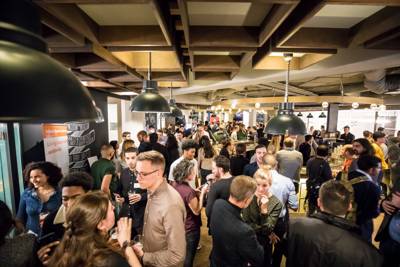
The backbone of Venture Café – come meet the community and make connections with all different kinds of innovators. How will you make your serendipitous moment come true?
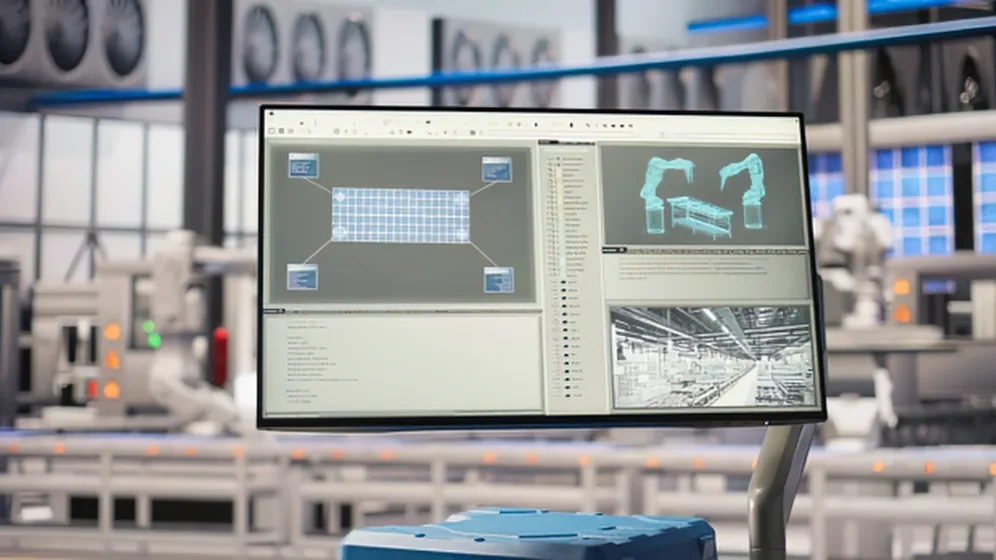
A firsthand look at how AI-powered design tools compressed months of product development into days — plus the room full of people building what's next in manufacturing, robotics, and AI.
"I want to show you something that changed the trajectory of my business."
Joe Kellogg
CEO, Kellogg's Research Labs
See the workflow live
A few months ago, Joe needed to design a CNC machine capable of handling Nitinol materials — traditionally a $2 million, year-long undertaking. Using Claude Fable‐powered Autodesk workflows, he built it in 30 days for a fully loaded cost of $12,000. He'll walk through the actual workflow live — not a case study, but the real process used to go from concept to a working machine design, a project that opened $1–30 million in potential new sales.
Why you should be there
If you're a founder building physical products, or an investor evaluating manufacturing and hardware bets, this is a rare, unfiltered look at how AI is rewriting the economics of design and production. Part of an ongoing series from the Center of Excellence for Manufacturing, Robotics, and AI, sharing the tools and hard-won lessons driving real results on the shop floor.
WHAT YOU'LL GET
– A live demo of the CAD-to-CNC AI workflow
– Real customer & partnership conversations
– Lessons from a 1,000x cost-reduction project
– A room of manufacturing, robotics & AI builders
This session is presented by Sbur, MassMEP, and Venture Café Cambridge.

Most teams know they should be thinking harder about cybersecurity, but few have a space to say out loud what worries them. Secure Now is a peer group hosted by Ebryx for founders, operators, and IT leads who want to talk candidly about the security questions they're facing, from phishing attempts and vendor risk to compliance pressure and figuring out where to start. There's no pitch and no slide deck. You'll sit with experts alongside people facing the same challenges. Share what's working and what isn't, and leave with practical ideas and a few new people to call when something comes up. You don't need to be an expert to join, just curious and ready to compare notes.

Do you have a few habits you can't quite explain? Maybe it's the task that sits on your list week after week, the decision you keep circling back to, or the work you'd rather do yourself than hand to someone else. Most of us notice these patterns long before we understand where they come from.
Building a startup right now demands a lot: speed, clarity, and steady nerves through constant change. It's easy to treat our recurring habits as simple time management or discipline problems. Often, though, they began as ways of protecting ourselves, and they keep shaping how we decide, lead, and collaborate long after we've outgrown the need for them. Maybe you've already felt the effect on your work, or you can see where a pattern might mean for your business if nothing shifts.
If you're an entrepreneur curious about what might sit beneath some of your habits, this is a welcoming place to start. The session offers space to explore old wounds through a business lens, connecting the patterns you carry with the way you run your work. This isn't about beating yourself up. It's a chance to look at your habits objectively, with compassion, in a safe room alongside other founders asking the same questions. You don't need a history of trauma to take part, and no one is asked to share more than they want to.
The trauma-informed lens is simply a useful backdrop for noticing what you've been carrying without realizing it. Think of this as an opening, a first look beneath the surface that may spark a deeper conversation later, and resources for continuing that work will be available.
In guided writing exercises, you'll find where these patterns show up in your work today. You'll stop asking "why do I keep doing this?" and start asking "what was this behavior trying to do for me, and is it still useful here?" You'll leave with more self awareness and a practical starting point for telling apart what once protected you from what serves you now.
Bob Moran, author of The Trauma-Informed Entrepreneur, guides the session and offers his own story as one lens for this exploration. He built his business on a social impact premise and brings lived experience to the room, not clinical training. He'll share how recognizing the impact of his own history changed the way he builds, along with the story of his mirror image clothing, which he created during one of the hardest periods of his life as a tool for coping and recovery. He'll bring a piece so you can feel it for yourself.
This session will be held in the Sonata Room with the curtains closed for privacy.
This session is not a substitute for therapy. Massachusetts residents can call or text the Massachusetts Behavioral Health Help Line at 833-773-2445, or visit masshelpline.com, for free 24/7 clinical assessment, treatment referrals, and crisis support. If you or someone you know is in crisis, call or text 988 to reach the Suicide & Crisis Lifeline.

Some people think AI will unlock more opportunities, creativity, and productivity than any technology in recent memory.
Others think we're underestimating the risks, overstating the benefits, and sleepwalking into consequences we don't fully understand.
They're probably both right.
Join Tech Runs Boston for a conversation exploring the biggest questions shaping the future of work, careers, and innovation.
We're bringing together young tech leaders to challenge assumptions, compare perspectives, and explore what's real, what's hype, and what tech professionals need to do to stay ahead.
Whether you're all-in on AI, deeply skeptical, or still figuring out where you stand, you'll leave with fresh perspectives, practical takeaways, and a better understanding of how AI is reshaping the world of work.
Tech Runs Boston is MTLC's quarterly series for young professionals in tech, hosted at Venture Café Cambridge.
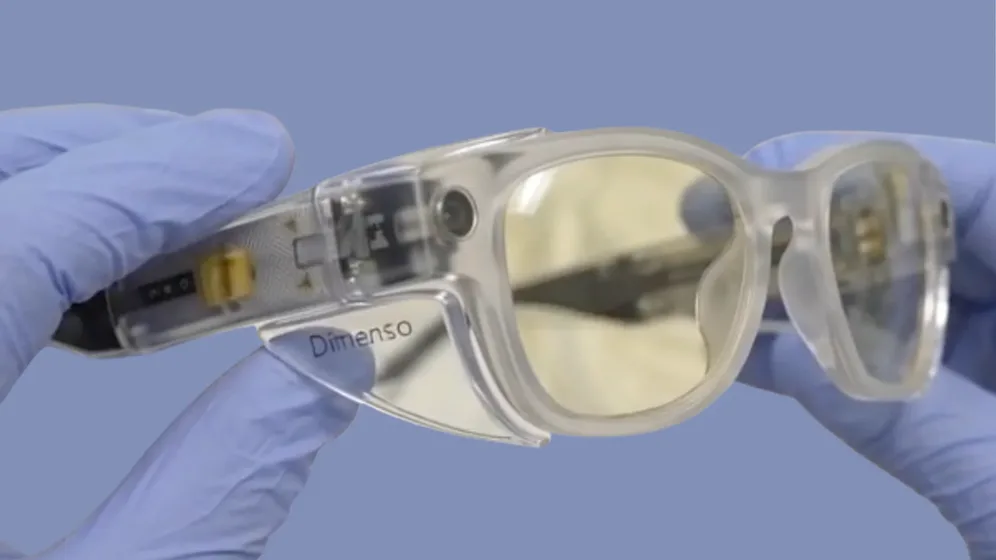
AI has transformed how we process information. Now, it is entering the physical world. In this session, Dimenso founder Luis Alvear will explore how AI-powered smart glasses can capture scientists’ work as it happens—structuring experimental data, detecting errors, and preserving the expertise behind complex laboratory procedures. He will also discuss how this real-world data can become the foundation for training humanoid robots to operate safely and effectively in biotech and pharmaceutical environments. The session will examine the challenges of bringing AI and robotics into highly technical labs, what these technologies can accomplish today, and how humans and robots may work together in the laboratories of the future.




The backbone of Venture Café – come meet the community and make connections with all different kinds of innovators. How will you make your serendipitous moment come true?
A firsthand look at how AI-powered design tools compressed months of product development into days — plus the room full of people building what's next in manufacturing, robotics, and AI.
"I want to show you something that changed the trajectory of my business."
Joe Kellogg
CEO, Kellogg's Research Labs
See the workflow live
A few months ago, Joe needed to design a CNC machine capable of handling Nitinol materials — traditionally a $2 million, year-long undertaking. Using Claude Fable‐powered Autodesk workflows, he built it in 30 days for a fully loaded cost of $12,000. He'll walk through the actual workflow live — not a case study, but the real process used to go from concept to a working machine design, a project that opened $1–30 million in potential new sales.
Why you should be there
If you're a founder building physical products, or an investor evaluating manufacturing and hardware bets, this is a rare, unfiltered look at how AI is rewriting the economics of design and production. Part of an ongoing series from the Center of Excellence for Manufacturing, Robotics, and AI, sharing the tools and hard-won lessons driving real results on the shop floor.
WHAT YOU'LL GET
– A live demo of the CAD-to-CNC AI workflow
– Real customer & partnership conversations
– Lessons from a 1,000x cost-reduction project
– A room of manufacturing, robotics & AI builders
This session is presented by Sbur, MassMEP, and Venture Café Cambridge.
Most teams know they should be thinking harder about cybersecurity, but few have a space to say out loud what worries them. Secure Now is a peer group hosted by Ebryx for founders, operators, and IT leads who want to talk candidly about the security questions they're facing, from phishing attempts and vendor risk to compliance pressure and figuring out where to start. There's no pitch and no slide deck. You'll sit with experts alongside people facing the same challenges. Share what's working and what isn't, and leave with practical ideas and a few new people to call when something comes up. You don't need to be an expert to join, just curious and ready to compare notes.
Do you have a few habits you can't quite explain? Maybe it's the task that sits on your list week after week, the decision you keep circling back to, or the work you'd rather do yourself than hand to someone else. Most of us notice these patterns long before we understand where they come from.
Building a startup right now demands a lot: speed, clarity, and steady nerves through constant change. It's easy to treat our recurring habits as simple time management or discipline problems. Often, though, they began as ways of protecting ourselves, and they keep shaping how we decide, lead, and collaborate long after we've outgrown the need for them. Maybe you've already felt the effect on your work, or you can see where a pattern might mean for your business if nothing shifts.
If you're an entrepreneur curious about what might sit beneath some of your habits, this is a welcoming place to start. The session offers space to explore old wounds through a business lens, connecting the patterns you carry with the way you run your work. This isn't about beating yourself up. It's a chance to look at your habits objectively, with compassion, in a safe room alongside other founders asking the same questions. You don't need a history of trauma to take part, and no one is asked to share more than they want to.
The trauma-informed lens is simply a useful backdrop for noticing what you've been carrying without realizing it. Think of this as an opening, a first look beneath the surface that may spark a deeper conversation later, and resources for continuing that work will be available.
In guided writing exercises, you'll find where these patterns show up in your work today. You'll stop asking "why do I keep doing this?" and start asking "what was this behavior trying to do for me, and is it still useful here?" You'll leave with more self awareness and a practical starting point for telling apart what once protected you from what serves you now.
Bob Moran, author of The Trauma-Informed Entrepreneur, guides the session and offers his own story as one lens for this exploration. He built his business on a social impact premise and brings lived experience to the room, not clinical training. He'll share how recognizing the impact of his own history changed the way he builds, along with the story of his mirror image clothing, which he created during one of the hardest periods of his life as a tool for coping and recovery. He'll bring a piece so you can feel it for yourself.
This session will be held in the Sonata Room with the curtains closed for privacy.
This session is not a substitute for therapy. Massachusetts residents can call or text the Massachusetts Behavioral Health Help Line at 833-773-2445, or visit masshelpline.com, for free 24/7 clinical assessment, treatment referrals, and crisis support. If you or someone you know is in crisis, call or text 988 to reach the Suicide & Crisis Lifeline.
Some people think AI will unlock more opportunities, creativity, and productivity than any technology in recent memory.
Others think we're underestimating the risks, overstating the benefits, and sleepwalking into consequences we don't fully understand.
They're probably both right.
Join Tech Runs Boston for a conversation exploring the biggest questions shaping the future of work, careers, and innovation.
We're bringing together young tech leaders to challenge assumptions, compare perspectives, and explore what's real, what's hype, and what tech professionals need to do to stay ahead.
Whether you're all-in on AI, deeply skeptical, or still figuring out where you stand, you'll leave with fresh perspectives, practical takeaways, and a better understanding of how AI is reshaping the world of work.
Tech Runs Boston is MTLC's quarterly series for young professionals in tech, hosted at Venture Café Cambridge.
AI has transformed how we process information. Now, it is entering the physical world. In this session, Dimenso founder Luis Alvear will explore how AI-powered smart glasses can capture scientists’ work as it happens—structuring experimental data, detecting errors, and preserving the expertise behind complex laboratory procedures. He will also discuss how this real-world data can become the foundation for training humanoid robots to operate safely and effectively in biotech and pharmaceutical environments. The session will examine the challenges of bringing AI and robotics into highly technical labs, what these technologies can accomplish today, and how humans and robots may work together in the laboratories of the future.